FreeNo adsNo sign-upsNothing collectedMade in the Blue Mountains
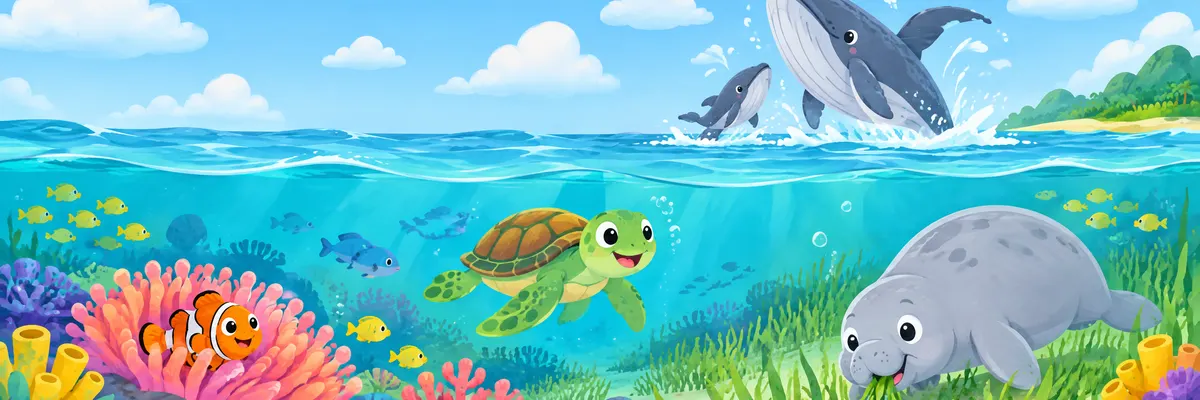
Australia's seas
Swim with the humpback whales up the east coast, help baby turtles to the sea, and meet who lives on the Great Barrier Reef, in the mangroves and in the kelp forests of the south.
Let's dive into Australia's seas!
For grown-ups: what each one teaches
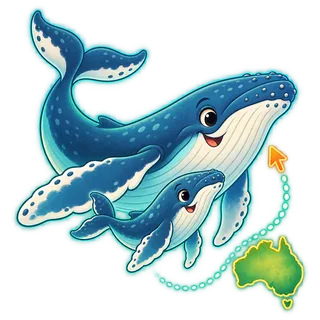
- The Whale Highway (ages 3–7). The humpback whales' journey up and down Australia's east coast: north to warm water in winter, where their calves are born, and home to Antarctica in spring. For grown-ups
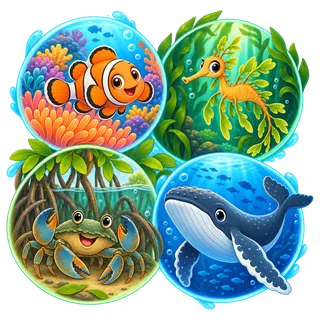
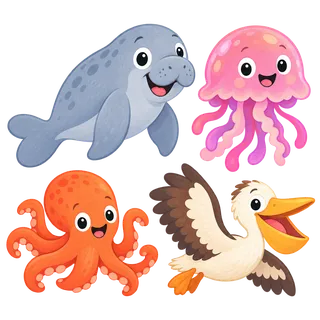
- Who Lives Where? (ages 3–7). Sorting Australian sea animals by where they live: the Great Barrier Reef, the open sea, the mangroves and the kelp forests of the south. For grown-ups
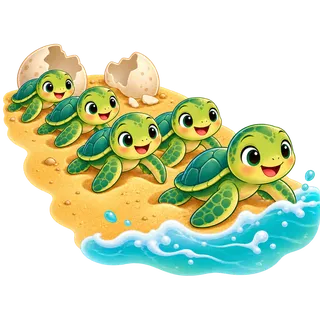
- Turtle Hatchlings (ages 4–7). Numbers to 10 and then 20, and counting on, as a baby green turtle scuttles down a Great Barrier Reef beach to the sea. For grown-ups
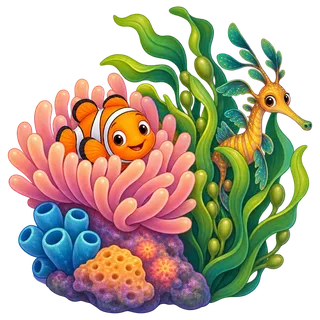
- Reef Hide and Seek (ages 2–4). Looking and finding, for the youngest: who's hiding on the reef, in the kelp and in the seagrass? For grown-ups
- Dugong Remembers (ages 3–6). Remembering things in order: watch and listen, then do it back.
Away from the screen
Next time you're at the beach or a rock pool, look closely and don't touch: count the shells, find something hiding, and leave every creature where it lives. In winter, look up when the whales are passing: lots of coastal towns have a lookout.
Every fact, and where it comes from
Everything Ruby Roo says in these games was checked against the page it links to, written for grown-ups to read.
- After a summer feeding on krill in Antarctic waters, humpbacks migrate north to sub-tropical waters, up to 10,000 km a year. (Australian Government (Save Our Whales))
- Most humpbacks in Australian waters migrate north from June to August and back towards the Southern Ocean from September to November. (Australian Government (Save Our Whales))
- Humpbacks mate and give birth in the warmer northern waters. (Australian Government (Save Our Whales))
- They feed on krill in Antarctic waters in summer. (Australian Government (Save Our Whales))
- Anemonefish live with anemones: they are immune to the stinging tentacles, which protect them, and they remove parasites and sediment from their host. (Great Barrier Reef Marine Park Authority)
- Giant clams are the largest mollusc on earth, growing over a metre long and living for over 100 years. (Great Barrier Reef Marine Park Authority)
- Six of the world's seven marine turtle species occur in the Great Barrier Reef World Heritage Area. (Great Barrier Reef Marine Park Authority)
- Turtles nest on the Reef's islands and Queensland's coast, from late October to February; Raine Island and Heron Island are key sites. (Great Barrier Reef Marine Park Authority)
- Hatchlings emerge from December to May and orient towards the brightest direction and the shape of the horizon. (Great Barrier Reef Marine Park Authority)
- Dugongs graze on seagrass meadows in sheltered coastal waters and must surface to breathe. (Great Barrier Reef Marine Park Authority)
- Weedy seadragons are found only in southern Australia, in kelp forests, seagrass meadows and sponge gardens; males carry the eggs on their tails until they hatch. (Derwent Estuary Program)
- The Australian sea lion is endemic, restricted to South Australia and Western Australia, breeding mostly on offshore islands. (South Australian Government (state of the environment report cards, 2023))
- Whale sharks are harmless filter feeders that eat plankton; they are most reliably seen at Ningaloo from March to July. (WA Department of Biodiversity, Conservation and Attractions)
- Estuarine crocodiles live in rivers, lagoons, swamps, mangroves, estuaries, beaches, coral reefs and the ocean in northern Australia. (Queensland Government)
- Mud crabs prefer shallow, muddy-bottomed mangroves, sheltered estuaries and tidal flats, from NSW around the north to Shark Bay. (Sydney Fish Market)
- White sharks occur in coastal, shelf and slope waters around southern Australia and travel long distances, to New Zealand and South Africa. (CSIRO)
What it practises
- Australian animals. What animals look like and where they live (My animal friends cards).
AC9SFU01 (Science, Foundation); AC9S1U01 (Science, Year 1) - Weather and seasons. Noticing the weather each day and how it changes with the seasons, and what to wear for it.
AC9S1U02 (Science, Year 1) - Sorting by two things. Putting things into groups by what they look like, then by two things at once: orange and round, small and pointy.
AC9MFSP01 (Mathematics, Foundation); AC9MFM01 (Mathematics, Foundation); EYLF 4.2 (Early Years Learning Framework V2.0) - Reading numbers. Knowing numerals and what they're called.
AC9MFN01 (Mathematics, Foundation) - Counting on. Starting from a number and counting on, on a number line to 20 (and, in Big Steps, to 100 in tens).
AC9MFN01 (Mathematics, Foundation); AC9MFN03 (Mathematics, Foundation); AC9M1N01 (Mathematics, Year 1) - Looking and finding. For two- and three-year-olds: looking for something hidden, and knowing it's still there when you can only see a bit of it.
EYLF 4.2 (Early Years Learning Framework V2.0)
What it costs, and what we collect
Nothing, and nothing.
Updated