Pelican's Patterns
Patterns: spotting what repeats, and working out what comes next
How it plays
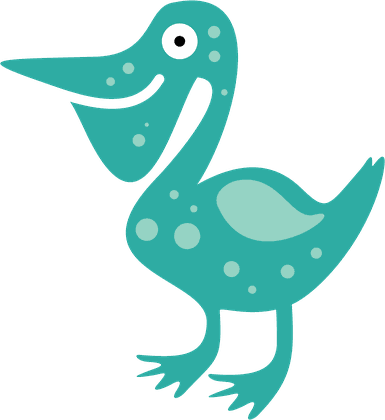
A row of shapes appears and is read aloud — circle, square, circle, square, circle… — and your child taps what comes next to pop it in the pelican's beak. Every shape in a pattern is a different shape, so it never depends on telling colours apart. It builds from two-step patterns (circle, square) to three things (circle, square, star) and doubles (circle, circle, square, square). It starts with two to choose from and offers more as your child gets them right; a wrong choice steps back quietly and the pattern is read again. "Hear it again" reads it any time.
What it's for
Patterns: spotting what repeats, and working out what comes next. It adapts as your child plays: after a few rounds that go well it steps up a little, and after a couple of hard ones it quietly steps back. The level number only ever goes up.
There is no score to lose and no way to fail. A wrong move is met with a gentle nudge, and a level ends when it's won.
Away from the screen: Pattern train
About two minutes, with things most homes have.
- Line up spoons and forks: spoon, fork, spoon, fork.
- Ask what comes next.
- Make a pattern for your child to finish, then let them make one for you.
Three questions to ask while they play
- Can you say the pattern out loud?
- Which part keeps repeating?
- What would come after that one?
Play together
Things to say or ask
- Say the pattern out loud: red, blue, red, blue…
- What comes next? How do you know?
- Can you clap the pattern?
Taking turns on one device: One player says the pattern aloud; the other picks what comes next. Swap each pattern.
Talk-about cards: a question a day for a week, for the car or the dinner table. Print them, or read them from your phone.
If they find it hard
Say the pattern together, pointing at each shape. Or try A Shape in its Place first: getting to know the shapes first.
A sheet to print
Print the Pelican's Patterns sheet
One A4 page, in black and white or colour.
From two to eight
Tiny Steps: made for two- and three-year-olds too. With Tiny Steps on, it stays on its gentlest level, a not-yet tap is never counted, and there's nothing to read.
Switch Tiny Steps or Big Steps on in Who's playing?, on the grown-ups' page.
What it practises
- Patterns. Seeing what repeats and working out what comes next.
AC9MFA01 (Mathematics, Foundation); AC9M1A02 (Mathematics, Year 1); EYLF 5.4 (Early Years Learning Framework V2.0) - Shapes. Naming and sorting circles, squares, triangles and stars.
AC9MFSP01 (Mathematics, Foundation) - Holding something in mind. Remembering a word or a pattern for a moment while you use it.
EYLF 4.2 (Early Years Learning Framework V2.0)
The codes are from the Early Years Learning Framework V2.0 (for children from birth to five) and the Australian Curriculum v9 (Foundation to Year 2). Each links to the official wording. Every skill, and the games for it.
What it costs, and what we collect
Nothing, and nothing. There is no account, no advertising and no tracking of any kind. Which games have been played is remembered on your own device and is never sent anywhere. The full version is here, and it's short.
Where it lives
Pelican's Patterns lives in The Bright Spot — shapes, colours and noticing. It works on a phone, a tablet or a classroom screen, and once it's been opened it keeps working with no signal at all.
Updated