FreeNo adsNo sign-upsNothing collectedMade in the Blue Mountains
Our World
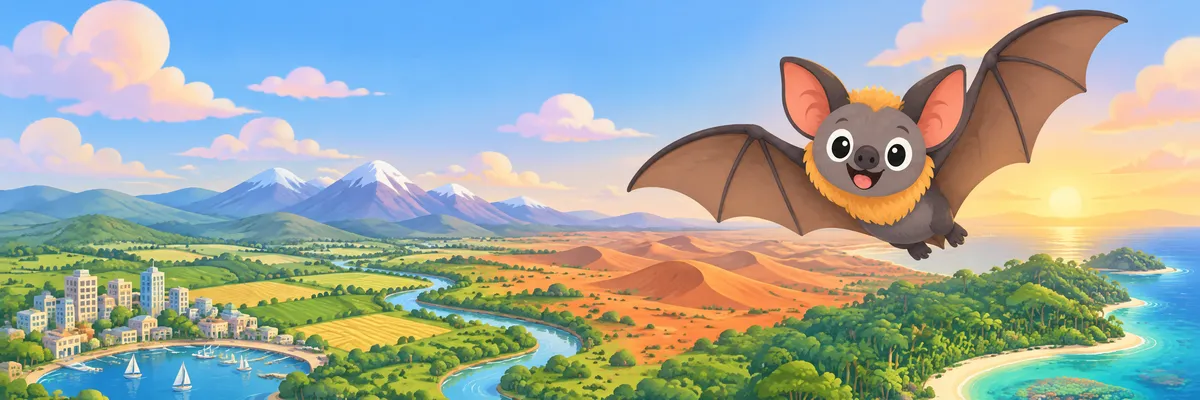
Fly with Flying-fox from the city to the snow, the desert, the rainforest and the Reef; match homes to their places; sort the bins; and find the little things that help our world.
Let's fly around our world!
For grown-ups: what each one teaches
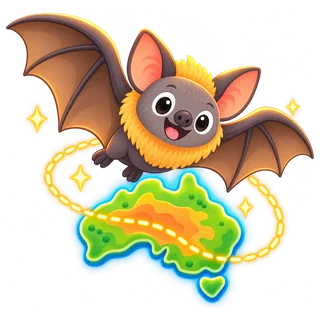
- Fly Around Australia (ages 4–7). Australia's very different places, on a map: a big city, the Snowy Mountains, the red centre's deserts, the rainforest and the Reef. For grown-ups
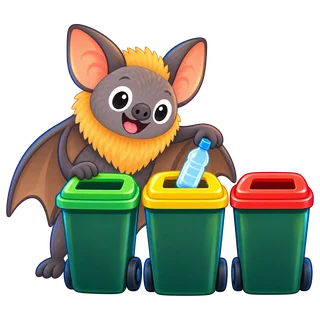
- Which Bin? (ages 3–7). Sorting into the green, yellow and red-lid bins most councils use. Check your own council's bins. For grown-ups
- Homes, Homes, Homes (ages 3–6). Homes are different, and they're all homes: city, farm, river, outback, beach, and animal homes too. For grown-ups
- Little Helpers (ages 3–6). Small, hopeful things that help: tap off, lights off, litter in the bin, a tree to plant. For grown-ups
- Day and Night (from sky and seasons). Why we have day and night: the spinning Earth, from the Sky and Seasons place.
Away from the screen
Go on a bin walk: which bins does your street use, and what colours are the lids? Draw a map of your room or your street, with a cross where you sleep. Turn the tap off together while you brush your teeth.
Safety: Councils use different bins, so check what goes where on your council's website. Rubbish is for grown-ups to handle; children can help sort clean things. Goulburn Mulwaree Council.
Every fact, and where it comes from
Everything Ruby Roo says in these games was checked against the page it links to, written for grown-ups to read.
- Flying-foxes travel long distances each night (up to 50 km) between their roosts and feeding sites, pollinating plants and spreading seeds as they go: they help keep eastern and northern Australia's woodlands healthy. (Australian Wildlife Conservancy)
- Mount Kosciuszko, in New South Wales, is the highest mountain on mainland Australia, at 2,228 metres. Australia is the lowest continent, with an average height of only 330 metres. (Geoscience Australia)
- Ten deserts make up nearly 20 per cent of mainland Australia. The largest, the Great Victoria Desert in Western Australia and South Australia, covers about 348,750 square kilometres. (Geoscience Australia)
- The Wet Tropics of north-east Queensland are the oldest continuously surviving tropical rainforests on Earth, World Heritage listed since 1988, with over 3,000 plant species. (Wet Tropics Management Authority)
- The Great Barrier Reef is the world's largest coral reef ecosystem: more than 3,000 separate reefs and about 1,050 islands and cays over some 348,000 square kilometres. It has been World Heritage listed since 1981. (Great Barrier Reef Marine Park Authority)
- Sydney is Australia's largest city, with about 5.6 million people (June 2025); more than 18 million Australians live in a capital city. (Australian Bureau of Statistics)
- Coober Pedy, an opal-mining town in outback South Australia, averages about 37 degrees on summer days, so many people live in 'dugouts' cut into the sandstone, which stay between about 19 and 25 degrees all year. (ABC News)
- Wombats are among the world's largest burrowing animals and spend about two thirds of their lives in their burrows. (Australian Museum)
- Common brushtail possums are nocturnal; by day they rest in a hollow log, branch or tree trunk, or any dark spot, even a house roof. (Australian Museum)
- Most councils use three lid colours: green for food and garden waste, yellow for clean recycling (paper and cardboard, glass bottles and jars, cans, hard plastics), and red for general waste, including soft plastics like chip packets. Councils differ, so check yours. (Goulburn Mulwaree Council)
- A running tap can use up to 10 litres a minute; turning it off while brushing teeth is one of the simplest water savers. (Government of Western Australia (Water Corporation))
What it practises
- Looking and finding. For two- and three-year-olds: looking for something hidden, and knowing it's still there when you can only see a bit of it.
EYLF 4.2 (Early Years Learning Framework V2.0) - Australian animals. What animals look like and where they live (My animal friends cards).
AC9SFU01 (Science, Foundation); AC9S1U01 (Science, Year 1) - Sorting by two things. Putting things into groups by what they look like, then by two things at once: orange and round, small and pointy.
AC9MFSP01 (Mathematics, Foundation); AC9MFM01 (Mathematics, Foundation); EYLF 4.2 (Early Years Learning Framework V2.0) - Noticing what's the same. Looking closely to find two that match.
EYLF 4.2 (Early Years Learning Framework V2.0) - Getting along with others. Taking turns, sharing, losing well, having a go, saying sorry, and noticing when a friend is sad.
AC9HPFP02 (Health and Physical Education, Foundation); AC9HPFP04 (Health and Physical Education, Foundation); EYLF 2 (Early Years Learning Framework V2.0)
What it costs, and what we collect
Nothing, and nothing.
Updated