FreeNo adsNo sign-upsNothing collectedMade in the Blue Mountains
Food & Cooking
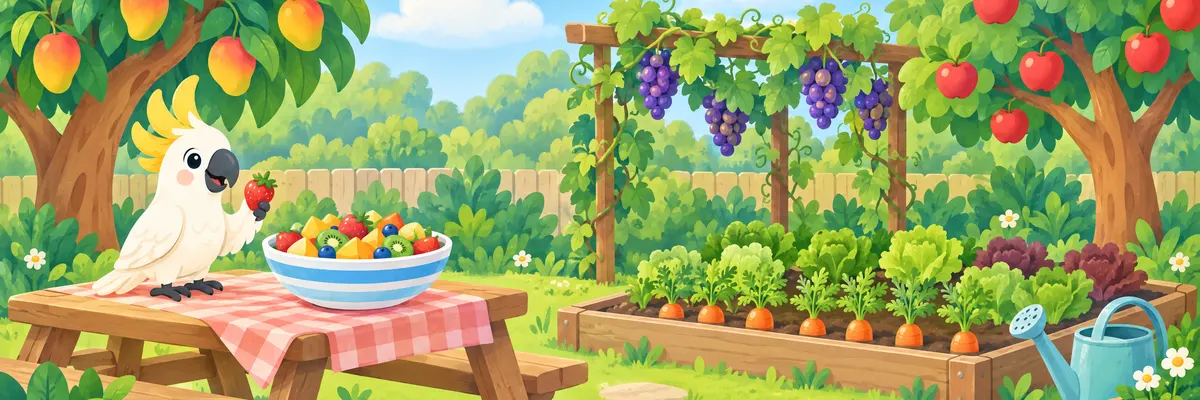
Find out where food grows, make a fruit salad step by step, share the fruit fairly between friends, and make a funny face on a plate.
Let's get cooking!
For grown-ups: what each one teaches
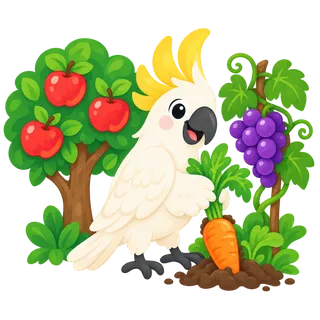
- Where Does It Grow? (ages 3–6). Where food comes from: on a tree, on a vine, or under the ground. For grown-ups
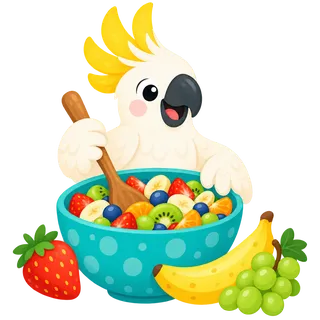
- Fruit Salad (ages 4–7). Putting steps in order: make a fruit salad safely, and grow a tomato from a seed. For grown-ups
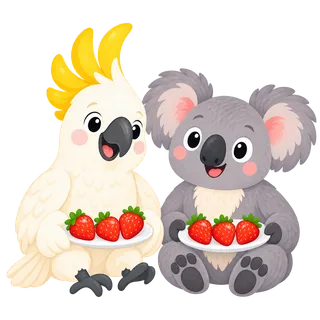
- Fair Shares (ages 4–7). Early sharing and dividing: share the fruit so every friend has the same, and count each plate. For grown-ups
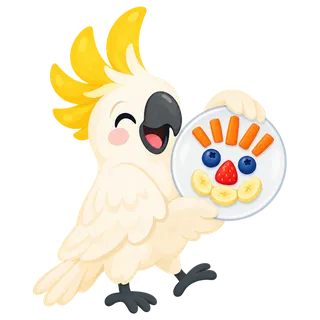
- Make a Plate Face (ages 3–6). Counting, and playing with food's colours and shapes: make a funny face on a plate, counted out loud. For grown-ups
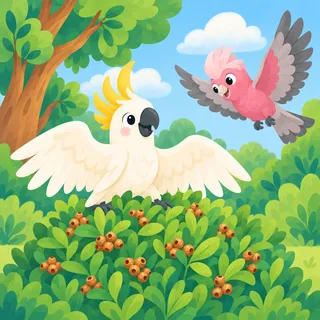
- Cockatoo's Big Feast (a listening story). Sharing the seeds with friends.
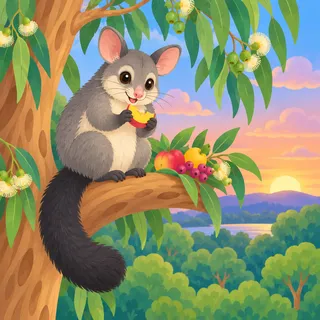
- Possum's Lunch (a little roos reader). A first book to read.
Away from the screen
Make a snack together: wash your hands, wash the fruit, and let a grown-up do the cutting. Count the pieces, share them out so everyone has the same, and see if you can make a face on your plate.
Every fact, and where it comes from
Everything Ruby Roo says in these games was checked against the page it links to, written for grown-ups to read.
- Macadamias are Australian trees, found naturally from north-east New South Wales to south-east Queensland. (Royal Botanic Garden Sydney)
- A peanut flowers above ground, then sends a shoot (a peg) into the soil, where the nut forms in its shell. (Northern Territory Government)
- The potato we eat is the tuber: the swollen end of the plant's underground stems. (Britannica Kids)
- The carrot is a root vegetable; the part we eat is the taproot, which grows underground. (Kids' Country (East of England Agricultural Society))
- The watermelon plant is a trailing annual with long running stems and tendrils. (Britannica Kids)
- The grape is usually a woody vine, climbing by means of tendrils. (Encyclopaedia Britannica)
- Tomatoes are green when unripe and slowly change from green to red as they ripen. (Kids' Country (East of England Agricultural Society))
- Wash and dry your hands when handling food, and wash fruit and vegetables. (NSW Food Authority)
- The five food groups are vegetables and legumes/beans; fruit; grain foods; lean meats and poultry, fish, eggs, tofu, nuts and seeds, and legumes/beans; and milk, yoghurt, cheese and/or alternatives. (For grown-ups only: the games never call a food good or bad.) (Sydney Children's Hospitals Network)
What it practises
- Sorting by two things. Putting things into groups by what they look like, then by two things at once: orange and round, small and pointy.
AC9MFSP01 (Mathematics, Foundation); AC9MFM01 (Mathematics, Foundation); EYLF 4.2 (Early Years Learning Framework V2.0) - Putting a story in order. Retelling a story from its pictures: what happened first, next and last.
AC9EFLE03 (English, Foundation); AC9EFLE05 (English, Foundation); AC9EFLY05 (English, Foundation) - Life cycles. How living things grow and change: egg, tadpole, frog; egg, caterpillar, chrysalis, butterfly. Life cycles are a Year 3 outcome, so this is a gentle early start.
AC9S3U01 (Science, Year 3); AC9S1U01 (Science, Year 1) - Reading numbers. Knowing numerals and what they're called.
AC9MFN01 (Mathematics, Foundation) - Getting along with others. Taking turns, sharing, losing well, having a go, saying sorry, and noticing when a friend is sad.
AC9HPFP02 (Health and Physical Education, Foundation); AC9HPFP04 (Health and Physical Education, Foundation); EYLF 2 (Early Years Learning Framework V2.0) - Drawing and colouring. Making pictures: choosing colours and patterns, filling shapes, and drawing ideas of your own.
AC9AVAFC01 (Visual Arts, Foundation); AC9AVAFD01 (Visual Arts, Foundation)
What it costs, and what we collect
Nothing, and nothing.
Updated