
Feelings and friends
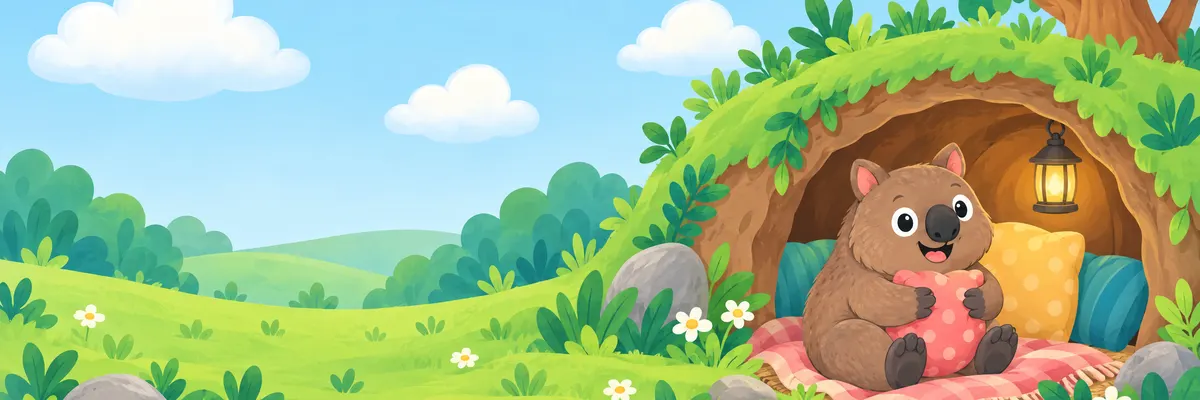
Six short stories about everyday moments, where your child chooses what the animal does next, and a “How am I feeling?” check-in with something that helps for each feeling. In the Cosy Burrow.
The stories
Each story is read aloud by Ruby Roo. At a choice, your child picks what happens. There are no wrong endings: a choice that doesn't go well is talked through (“How does Possum feel?”), and then the choice comes back to try again. Every story ends kindly. The pauses that ask how someone feels have no wrong answer; they're your cue to talk.
Quokka's Turn
Waiting your turn. Waiting your turn: asking for a turn, and waiting for it.
- What should Quokka do? Shout, 'Get off! It's my turn!' or Ask, 'Can I have a turn next?'
Talk about it: “Waiting is hard. What helps you wait?” “What could you count to while you wait?”
Play together: “Waiting is hard. What helps you wait?” “How did Possum feel?” “Whose turn is it next?” Taking turns: Take turns tapping Next, just like Quokka and Possum took turns on the swing.
Where the idea comes from: Raising Children Network, Raising Children Network
Wombat and the Big Red Ball
Sharing. Sharing: playing together instead of keeping something to yourself.
- What should Wombat say? Say, 'Yes! Let's play together.' or Say, 'No! It's mine!'
Talk about it: “What's something you like to share?” “How do you feel when someone shares with you?”
Play together: “What's something you like to share?” “How did Quokka feel when Wombat shared?” “Is a game more fun with a friend?” Taking turns: Take turns tapping Next, and take turns choosing what Wombat does.
Where the idea comes from: Raising Children Network, Raising Children Network
Platypus and the Big Race
Losing a game. Losing a game: big feelings, and being a good sport.
- What should Platypus do? Stomp and shout, 'Not fair!' or Say, 'Well done, Echidna!'
Talk about it: “How do you feel when you lose a game?” “What can you say to someone who wins?”
Play together: “How do you feel when you lose a game?” “What could Platypus say to Echidna?” “What's fun about playing, even when you don't win?” Taking turns: At the choice, one player picks; next time the other picks. Talk about each one.
Where the idea comes from: Raising Children Network, Raising Children Network
Koala Has a Go
Trying something new. Trying something new: feeling nervous, and having a go anyway.
- What should Koala do? Have a go, one little brush stroke at a time or Say, 'I can't,' and sit in the corner
Talk about it: “What's something new you tried?” “How did you feel before, and after?”
Play together: “What's something new you'd like to try?” “How did Koala feel after she had a go?” “It's OK to make a mess when you're learning.” Taking turns: At the choice, one player picks; next time the other picks. Talk about each one.
Where the idea comes from: Raising Children Network, Raising Children Network
Possum Says Sorry
Saying sorry. Saying sorry: owning up to an accident, and helping to fix it.
- What should Possum do? Run away and hide or Say sorry, and help build it again
Talk about it: “When did you last say sorry?” “What else can help, after sorry?”
Play together: “How did Echidna feel when her tower fell?” “What can we do to help after an accident?” “When have you said sorry?” Taking turns: At the choice, one player picks; next time the other picks. Talk about each one.
Where the idea comes from: Raising Children Network, Raising Children Network
Wallaby and the Sad Friend
A friend who's sad. A friend who's sad: noticing, asking 'Are you OK?', and staying close.
- What should Wallaby do? Sit with Lizard, and ask, 'Are you OK?' or Keep hopping, and pretend not to see
Talk about it: “What could you do if a friend looked sad?” “What helps you when you feel sad?”
Play together: “How could you tell Lizard was sad?” “What can you do when a friend is sad?” “Who helps you when you're sad?” Taking turns: At the choice, one player picks; next time the other picks. Talk about each one.
Where the idea comes from: Raising Children Network, Raising Children Network
How am I feeling?
Eight faces, the same as Koala's Calm-Down and Talk: happy, calm, excited, tired, sad, angry, scared and worried. A tap names the feeling, says it's OK, and offers one thing that can help. For big feelings there's a door to Koala's slow breathing. Nothing is kept: how your child feels is never stored or sent.
- Happy: Tell someone what made you happy. (Raising Children Network)
- Calm: Calm is a good time to read a story, or sing a quiet song. (Raising Children Network)
- Excited: Clap your hands, and jump up and down on the spot. (Raising Children Network)
- Tired: Find a quiet place to rest, or listen to some quiet music. (Raising Children Network)
- Sad: Ask a grown-up for a hug. (Raising Children Network)
- Angry: Squeeze a cushion hard, then let go. Then take five big, slow breaths. (Raising Children Network)
- Scared: Tell a grown-up what feels scary. They can help. (Raising Children Network)
- Worried: Talk about your worry with a grown-up. Then count slowly to ten. (Raising Children Network)
A note for grown-ups
These are everyday moments, not a programme for big worries. If you're concerned about how your child is feeling or behaving, talk to your GP, child and family health nurse, or your child's educator.
Away from the screen
Play a turn-taking game together (snap, or rolling a ball back and forth) and say “my turn, your turn” out loud. At bedtime, ask “What felt good today? What felt hard?”
What it practises
- Naming feelings. Knowing and naming how you feel.
AC9HPFP03 (Health and Physical Education, Foundation); EYLF 1 (Early Years Learning Framework V2.0); EYLF 3 (Early Years Learning Framework V2.0) - Getting along with others. Taking turns, sharing, losing well, having a go, saying sorry, and noticing when a friend is sad.
AC9HPFP02 (Health and Physical Education, Foundation); AC9HPFP04 (Health and Physical Education, Foundation); EYLF 2 (Early Years Learning Framework V2.0)
What it costs, and what we collect
Nothing, and nothing. The stories keep only the gold words your child has heard, for My word treasure, on your own device. The check-in keeps nothing at all.
Updated