FreeNo adsNo sign-upsNothing collectedMade in the Blue Mountains
Fossil Finders
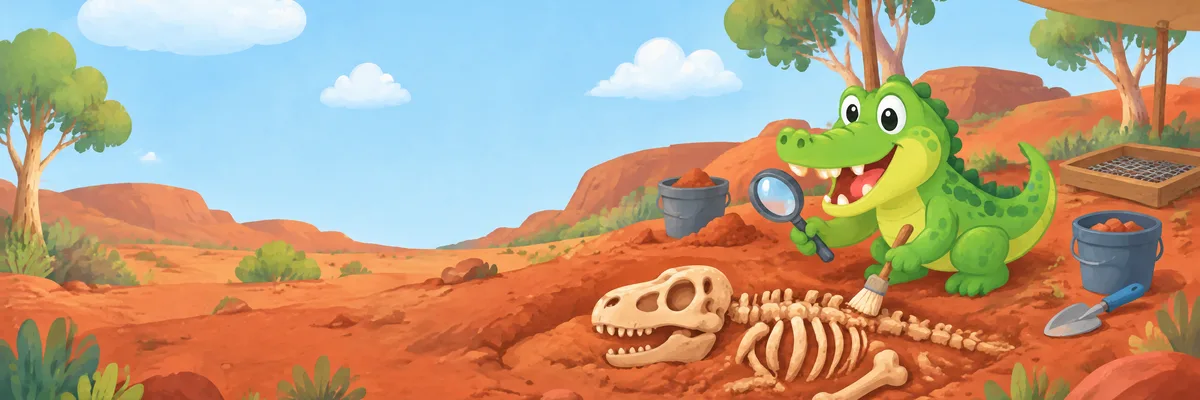
Brush the sand off fossils, build a skeleton bone by bone, sort who lived long ago from who lives today, and read footprints like a fossil hunter.
Let's dig for fossils!
For grown-ups: what each one teaches
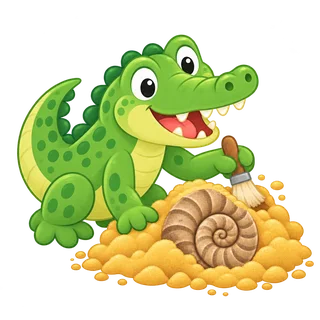
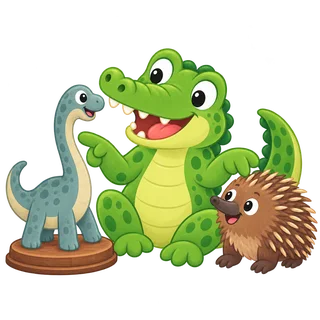
- Dig It Up! (ages 2–5). What fossils are: bones, teeth, shells, plants and footprints from long ago that turned to rock. For grown-ups
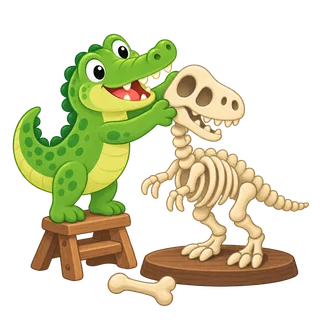
- Bone by Bone (ages 4–7). Putting steps in order, the way a museum builds a skeleton: a Muttaburrasaurus and a Diprotodon. For grown-ups
- Long Ago or Today? (ages 3–6). Sorting animals we know from fossils and animals alive today. For grown-ups
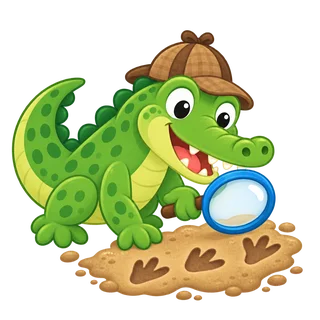
- Footprint Detectives (ages 3–6). Reading footprints, today and long ago: three toes, two feet, round paws. For grown-ups
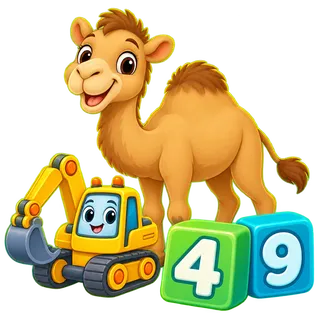
- Bigger Than a Digger (ages 5–8). Which numbers are bigger and which are smaller.
Away from the screen
Look for footprints outside: in sand, mud or on a dusty path. Whose are they? A galah's, a lizard's, yours? Press a leaf or a shell into playdough and see the print it leaves, just like a fossil.
Every fact, and where it comes from
Everything Ruby Roo says in these games was checked against the page it links to, written for grown-ups to read.
- Most fossils form when a plant or animal dies in water and is buried in mud and silt; the soft parts rot away, the hard bones or shells are left, and over time the layers harden into rock. Bones, teeth, footprints and even droppings can be fossils. (Australian Museum)
- Footprints are fossils too: they record where an animal walked, not just what it looked like. (Australian Museum)
- Muttaburrasaurus was discovered near Muttaburra in central Queensland. About 7 metres long, it was mainly or entirely a plant-eater with an unusual rounded bony snout, and lived between about 125 and 100 million years ago. (Australian Museum)
- Diamantinasaurus, nicknamed Matilda, was a titanosaur (a long-necked sauropod) found near Winton in central Queensland. It was about 15 metres long, a plant-eater, and lived in the Late Cretaceous, about 90 million years ago. (Australian Museum)
- Leaellynasaura, from Dinosaur Cove in Victoria, was about a metre long and ate low plants such as ferns. Its enlarged eye sockets may have helped it see through dark polar winters, when Victoria lay near the South Pole, about 106 million years ago. (Australian Museum)
- Diprotodon optatum is the largest marsupial known: up to 3.8 metres long, 1.7 metres at the shoulder and about 2,800 kilograms. Its feet turned in, as in wombats. Hundreds have been found at Lake Callabonna in South Australia. It became extinct about 25,000 years ago. (Australian Museum)
- Lark Quarry, in outback Queensland near Winton, has more than 3,300 dinosaur footprints in a fossilised rock face. They were long thought to be a stampede, about 95 million years ago; another idea is that a flock of small two-legged dinosaurs was crossing a river. (Queensland Parks and Wildlife Service)
- Isisfordia, a crocodile relative from Queensland that lived about 100 million years ago alongside the dinosaurs, is the oldest known direct ancestor of living crocodiles. (Australian Museum)
- Lightning Ridge, in New South Wales, has the greatest number and variety of opalised fossils in Australia: dinosaurs, turtles, crocodiles, fish, early mammals, shells, pine cones and seeds. (Australian Geographic)
What it practises
- Looking and finding. For two- and three-year-olds: looking for something hidden, and knowing it's still there when you can only see a bit of it.
EYLF 4.2 (Early Years Learning Framework V2.0) - Australian animals. What animals look like and where they live (My animal friends cards).
AC9SFU01 (Science, Foundation); AC9S1U01 (Science, Year 1) - Putting a story in order. Retelling a story from its pictures: what happened first, next and last.
AC9EFLE03 (English, Foundation); AC9EFLE05 (English, Foundation); AC9EFLY05 (English, Foundation) - Sorting by two things. Putting things into groups by what they look like, then by two things at once: orange and round, small and pointy.
AC9MFSP01 (Mathematics, Foundation); AC9MFM01 (Mathematics, Foundation); EYLF 4.2 (Early Years Learning Framework V2.0)
What it costs, and what we collect
Nothing, and nothing.
Updated